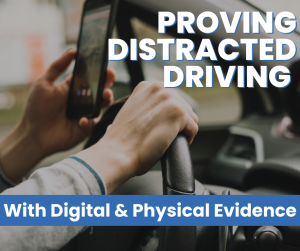
Distracted driving accidents can be difficult to prove, but a careful combination of digital records, eyewitness accounts, and physical evidence can reveal exactly what happened in the moments before a crash. By connecting these details, investigators can show how a driver’s attention was diverted and how that distraction contributed to the collision. Understanding how this evidence works together is essential to building a strong personal injury claim.
Each type of information offers a different piece of the puzzle. When attorneys move quickly to preserve phone data, video footage, and vehicle records, they have a better chance of demonstrating negligence and protecting an injured person’s rights.
Digital Evidence: Following the Driver’s Electronic Activity
One of the clearest ways to identify distracted driving is through data pulled from a driver’s mobile device. Phone call logs, text message timestamps, and app activity can show whether the driver was using their device at or near the time of impact. Even without reading the content of a message, the timing alone can strongly indicate distraction.
Accessing this information, however, is not always straightforward. Carriers often store records for limited periods of time, and requesting them typically requires legal action. In more complex cases, forensic experts may analyze the phone itself to uncover deleted activity or determine whether the driver was using navigation tools, scrolling through apps, or interacting with social platforms moments before the crash.
Social media behavior and location tracking can also contribute valuable insight. Posts, check-ins, or live interactions that occur close to the time of the accident may reveal whether the driver’s attention was on their screen instead of the road. When combined with phone records, this digital evidence can help establish a convincing narrative of inattention.
Eyewitness Testimony and Video Evidence
Eyewitnesses often provide essential context in distracted driving cases. Other drivers, passengers, or bystanders may observe behaviors such as a driver looking down, holding a device, or appearing disengaged just before the collision. These accounts add a firsthand perspective that supports other forms of evidence.
Witnesses may also describe what happened immediately after the crash. For example, someone might recall seeing a lit-up phone on the driver’s seat or hearing them acknowledge they were using their device. These details help strengthen the argument that distraction contributed to the incident.
Video recordings offer another powerful source of proof. Traffic cameras, security systems, and dashcams often capture brief but critical moments. Footage showing a vehicle drifting between lanes, failing to slow down, or revealing the driver interacting with a device can significantly reinforce a claim. Because this material is frequently overwritten in a short period, attorneys must act quickly to request and preserve any available recordings.
Vehicle and Scene Evidence: Physical Indicators of Distraction
Modern vehicles store important data through their event data recorders (EDRs). These devices track factors such as steering inputs, acceleration, braking, and speed in the seconds leading up to a crash. When an EDR shows no braking or steering corrections before impact, it may indicate that the driver never saw the hazard—an important clue pointing to distraction.
Traditional accident scene evidence is equally significant. Skid marks, or the absence of them, reveal whether a driver attempted to stop. The pattern of vehicle damage and the placement of debris can help reconstruction experts determine how the collision occurred. For instance, a rear-end impact with no signs of braking often suggests the at-fault driver was not paying attention to the road.
Accident reconstruction specialists use this information to recreate the sequence of events and explain what actions the driver could have taken had they been fully focused.
Why Prompt Action Is Critical
Although these sources of evidence are extremely valuable, they are also time-sensitive. Phone records, social media data, and camera footage are frequently deleted or overwritten within days or weeks. Additionally, many types of digital information can only be accessed once formal legal procedures begin.
For these reasons, contacting a personal injury attorney as soon as distracted driving is suspected is one of the most important steps an injured person can take. A legal team can quickly issue preservation requests, secure video recordings, review crash scene findings, analyze vehicle data, and work with experts to build a strong case. Delaying this process can lead to the permanent loss of crucial details that may make a significant difference in the outcome of a claim.
Taking the First Step Toward Recovery
Establishing distracted driving requires more than assumptions—it demands timely evidence collection and a strategic legal approach. Whether the distraction involved texting, social media activity, or GPS use, identifying these behaviors is key to proving negligence and pursuing fair compensation.
If you believe distraction played a role in your accident, taking immediate action can help protect your rights. Consulting with a personal injury attorney ensures you have guidance from professionals who understand how to gather, preserve, and present the evidence needed for a strong case.
By acting quickly and seeking qualified help, you can begin building a well-supported claim and move forward with greater confidence in your pursuit of justice and recovery.

